

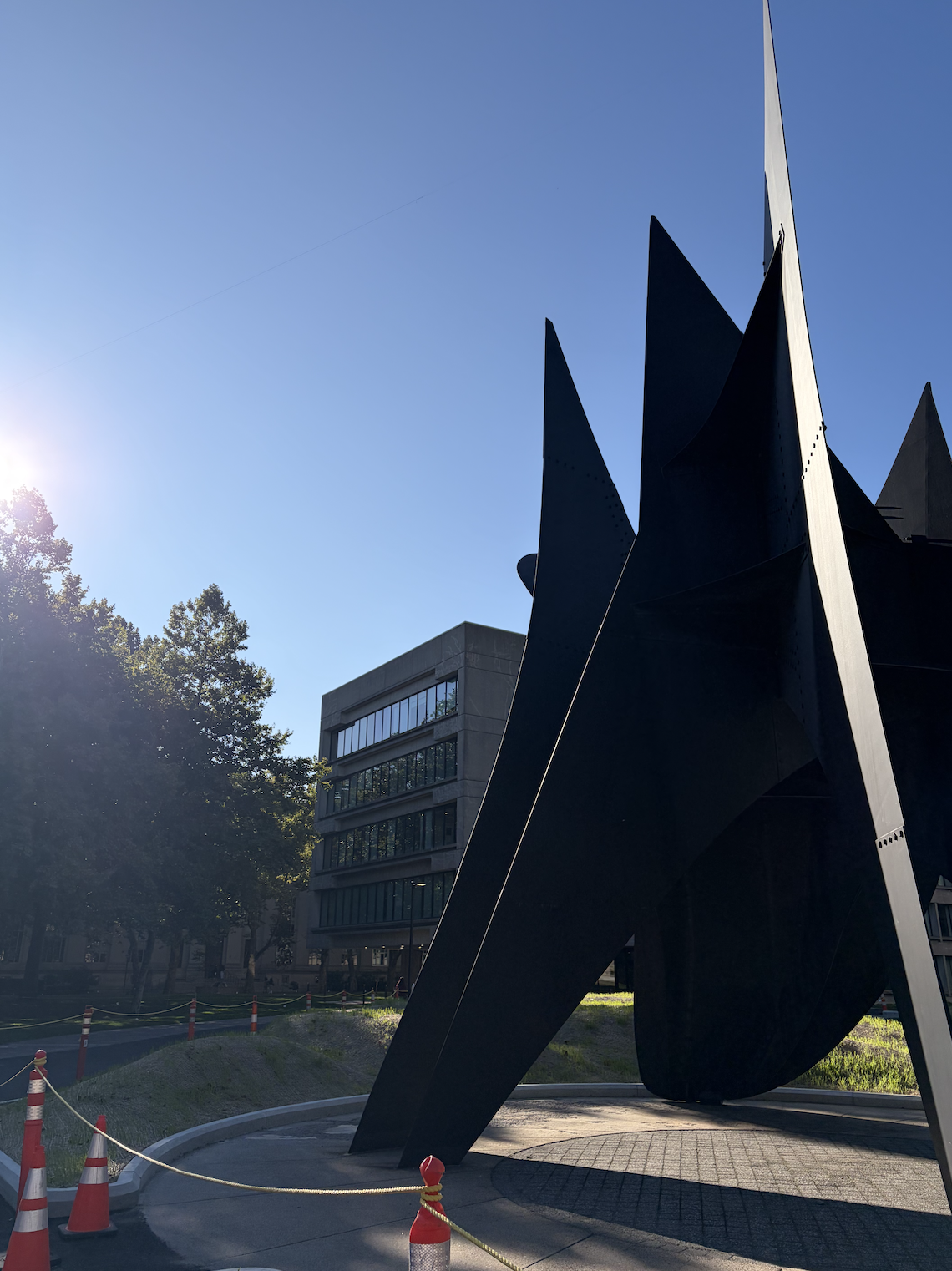
As a child, I fell in love with the Chasing Vermeer book series by Blue Balliett. The book series is based in Hyde Park, Chicago and follows friends Petra, Tommy, and Calder as they solve art-related mysteries. The final book in the series – The Calder Game – centering on character Calder from the series, made me fall in love with Alexander Calder’s (1898-1976) sculptures. The Flamingo outside of the Federal Building in Chicago is one of the spots on my “must see” Chicago tours, although up until now I have been unable to properly explain my enthusiasm for the orange, bending work of art to my out-of-town friends.
Naively, because of the books and the sculpture of my childhood being based in Chicago, I figured Calder was an American modern artist and that was the extent of his story. Imagine my surprise when my mom and I toured Rouen in northern France in September 2024 and found the Horizontal sculpture in the beautiful park outside the Musée des Beaux Arts. It is a huge sculpture of Calder’s classic mobiles, suspended geometric shapes that twist and turn around a wire because of shifts in the air. Like most modern art, the mobiles reveal different meaning from various perspectives, but the added element of this introspection depending solely upon the natural, unpredictable movement of wind makes it special.
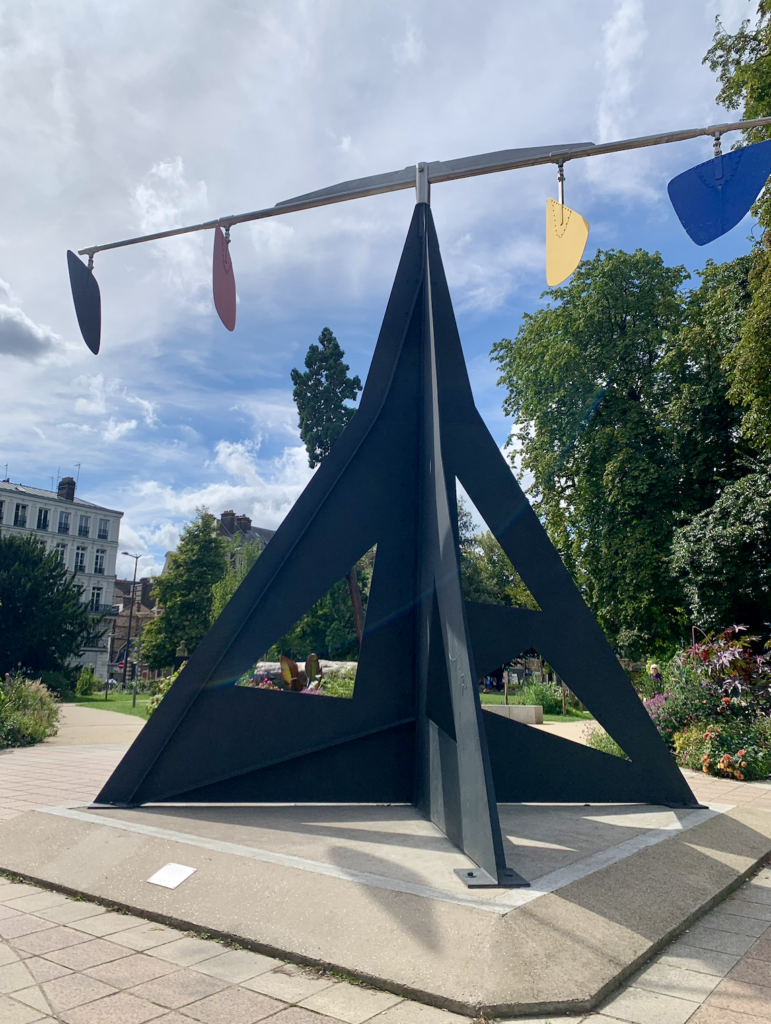
I spotted it while walking with my mom towards the square, immediately reacting “that looks like a Calder!” thinking it couldn’t possibly be, since he was American, and it must be either a copy or another artist inspired by his work. But lo and behold, it was a Calder! I was incredibly excited, feeling like one of the Chasing Vermeer gang across the pond, my mom, one of the first people who encouraged my love of reading, besides me.
Fast forward a year and a half and one of my life dreams has come true: I am living and studying in Paris. To my absolute delight, I saw a poster advertisement in the Paris metro one day for «Calder. Rêver en équilibre» at the Fondation Louis Vuitton. Viewing the special exhibit inside the spectacular Gehry building (with breathtaking views of the Paris skyline) became my reward to myself for submitting my PhD thesis. (Shout out to the friend who said I would enjoy the surrounding Bois de Boulogne too; you were right 🙂 ).
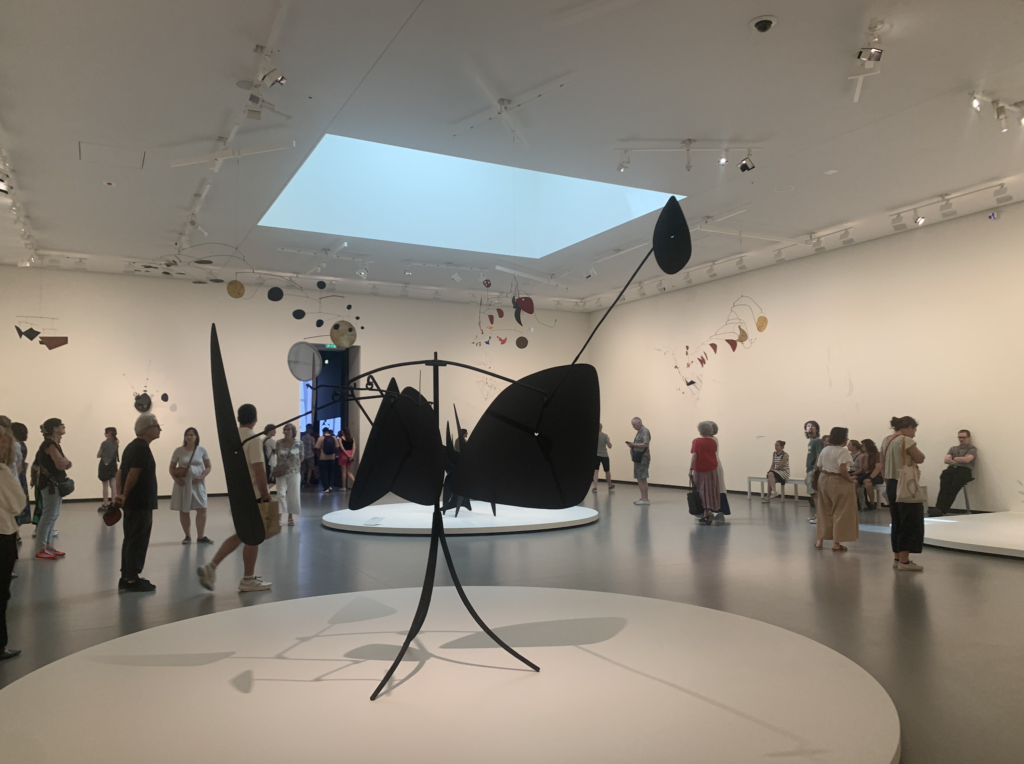
The special exhibit covered every facet of Alexander Calder’s life, from his 1920s Calder Circus (Cirque Calder) – his first project in Montparnasse in Paris – to the final stabiles (or static abstractions) he made at his French studio in Saché, complete with wonderful photography and video of the artist at work across the decades. Spanning from the basement all the way up to the Louis Vuitton Foundation’s top exhibition rooms that lead out onto its rooftop, the spectator moved through time and different themes of Calder’s stabile and mobile works.
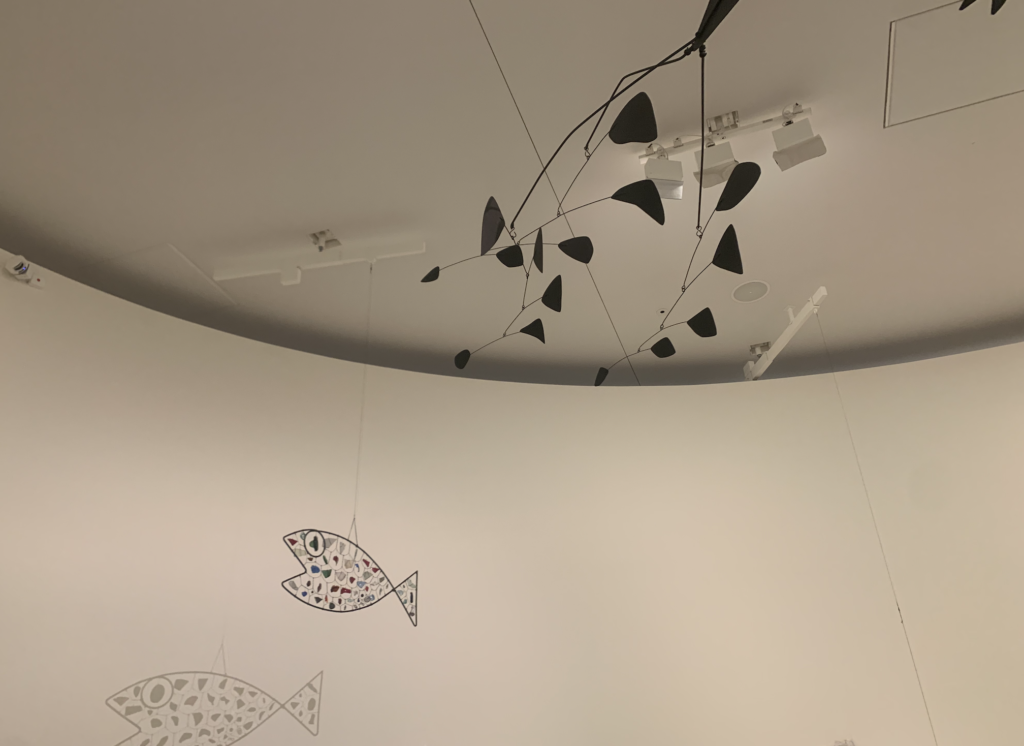
One of my favorite theme rooms displayed how Calder used glass he found on the beach, broken down by the ocean in such a way they appear like translucent shells or stones, interspersed with wire to create dazzling fish from the ceiling. The curvature of the exhibition room paired with the lighting created several silhouettes, making the room appear as if there were more fish in the room than reality. Another favorite mobile of mine, due to the location of the exhibition, was France Forever (1942), with symbolism from the colors of the French flag and the Croix de Lorraine of the Free France movement and the French Resistance. Calder’s completion of so many works of art back in the US during the Second World War not only showcase his close personal and professional connection to France, but also reflect the political realities of the time period in which he came of age as an artist.
Calder moved into the Montparnasse district of Paris in 1926, befriending other contemporary giants of modern art in the coming years. Among them were Marcel Duchamp and Pablo Picasso. Duchamp was even the one who first named Calder’s suspended works of wired art “mobiles.”[1] It was amongst these new European influences that Calder unveiled his Circus in the 1920s: wired figures of acrobats, ringleaders, animals, and aerialists. The two films that were part of the exhibit showed that while these figurines were petite and Calder appeared a giant as the master of his own puppetry with wire, the calculation required to move the wire figures in time with one another for the performance was impressive. The acrobatic movement of Cirque Calder reflect the exuberance and rampageous adventurousness of the 1920s. The mobiles that became Calder’s signature in the 1930s are not a contradiction with this earlier work in Paris, but instead show a further development of his abstraction. His art went from being a performance medium for a live audience to a suspended one for audiences of the present and future. With the Great Depression and the rapidly rising risk of violence on the European continent, the creation of works that endured on the ground (stabiles) and in the sky (mobiles), speak to me as a promise to find meaning from whatever materials remain available for expression. Calder’s works were a testament to the endurance of the human spirit, freedom, and transatlantic ties. Even though Calder had returned to the US earlier in the 1930s as war became more likely, Calder later presented alongside Picasso at the 1937 Spanish Republic Pavilion, which was a testament to the anti-fascist movement during the Spanish Civil War.
Finally, some fun facts about Calder I discovered: first, he began his career as an engineer, even though he had been tinkering with works of art (shown at the beginning of the exhibition) since he was a child. Second, his works of art were not limited to the abstract, but also the material and personal as he made incredible necklaces for his wife, Louisa and many others. Third, Calder, shortly before his death, declined the Presidential Medal of Freedom from President Ford in protest of the Vietnam War. His artwork and its connection to the politics of his time therefore last until his end.
[1] Jean-Paul Sartre would later write an essay on Calder’s mobiles in the mid-1940s, demonstrating how Calder, an American artist, was fully in conversation with contemporary French culture. I read his essay after writing this blog, and was captivated by Sartre’s comparison of the mobiles to “aeolian harps.”
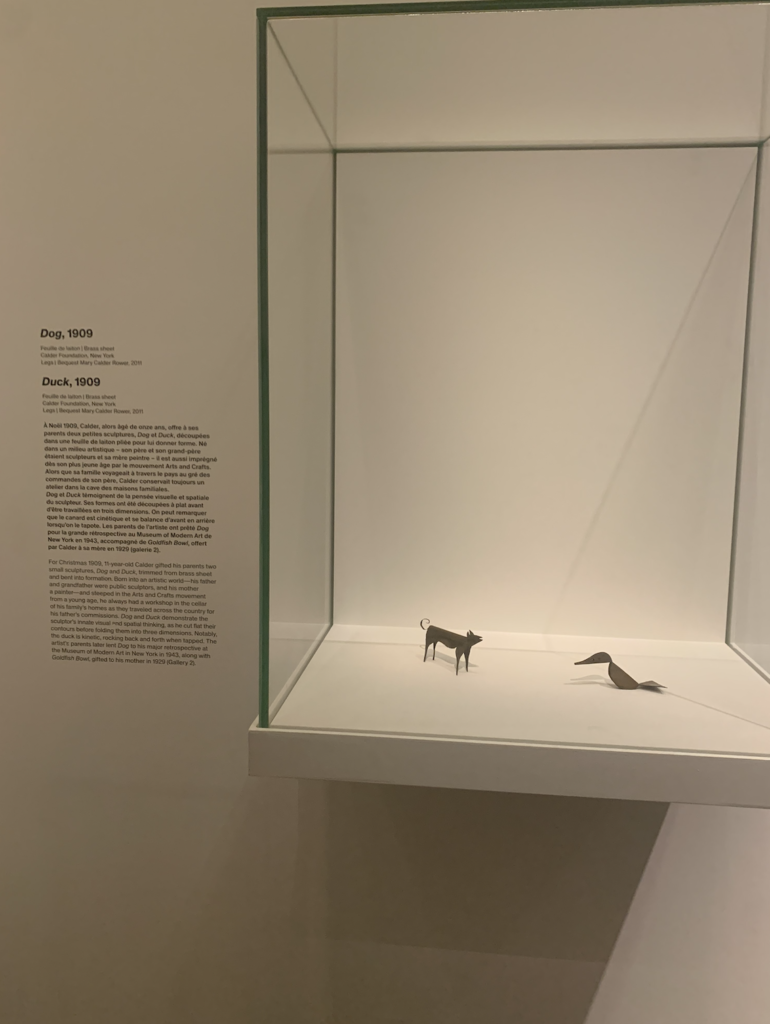
Reflecting on the few, cool (literally) hours I spent at the Calder exhibit, my need to peer up to the top of the Gehry tower, followed by my need to look up at the mobiles, and finally the slow, crowded march down from the top exhibition to the ground floor via the stairwell as many other Parisians used the exhibit as a way to cope with the June heatwave embodied what it’s like to make an artistic journey. Any type of journey really. Spiritual, emotional, or material, like my long journey to attempt to push our collective knowledge of political science a tad bit further with my four-year doctoral thesis. An adventure requires the unexpected, like the new and dramatic perspective I gained on Calder as a man and an artist, but also a purposeful beginning. The seed for my thesis being a desire in my first undergrad research class to understand the politics of the Sienese palio races in the town that I am named after, the root of my visit being one of the first books I ever fell in love with, and its connection to my first home (Chicago) and adopted home (Paris), in sharp relief of Calder’s own odyssey.
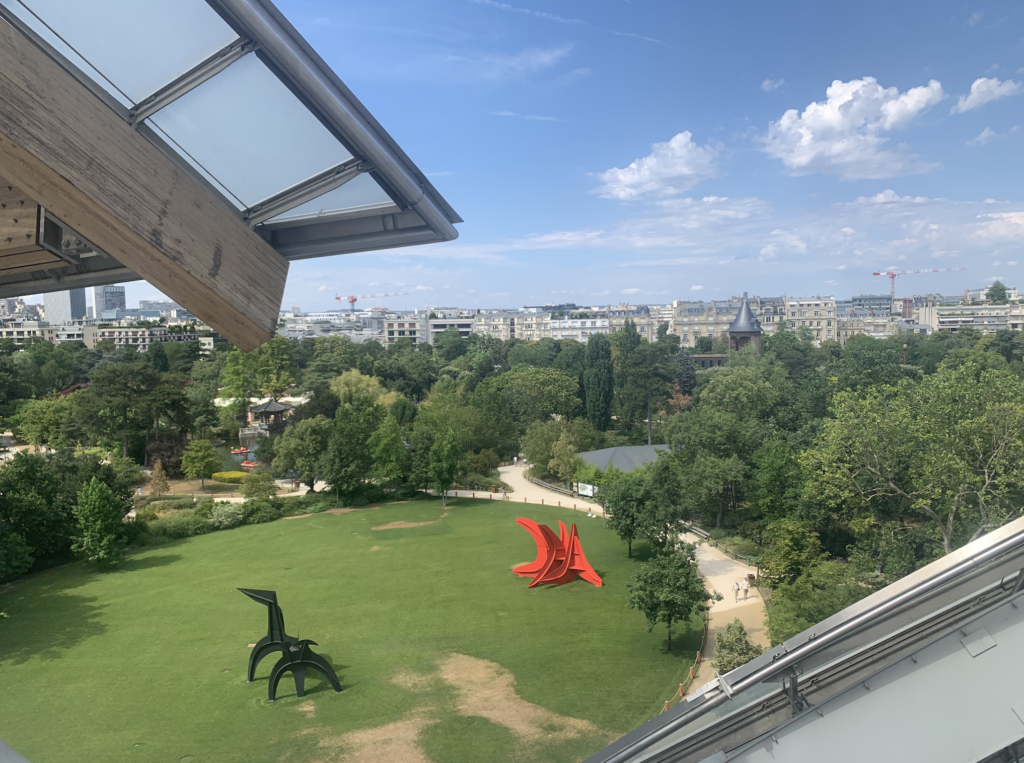
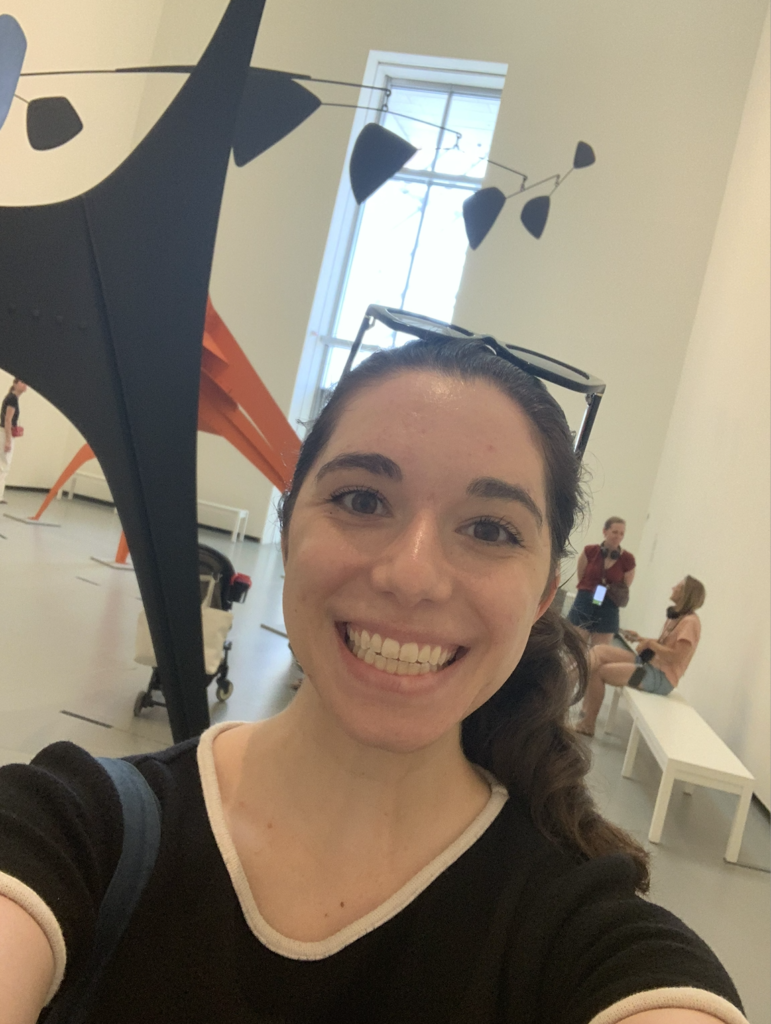
Finding Calder across the Atlantic, in my newfound home, and learning the storied history to Calder’s footsteps and workshops across Paris and France gave me a new hope and understanding of myself. A new hope that I can continue my side quests for my younger self who never had the chance to go abroad, wherever my career takes me, and fun to see how far my search for questions and answers, about who I am, the world, and even fun art puzzles from when I was younger, has taken me. May we each keep finding our own Calders!
Citations
Fondation Louis Vuitton. “Calder. Rêver en équilibre.” Paris, France, April 15-August 16, 2026.
Calder Foundation. 2026. <calder.org>. New York, NY.
Supplemented/verified exhibition notes by checking the official exhibition webpages:
https://www.fondationlouisvuitton.fr/en/events/calder-rever-en-equilibre
https://presse.fondationlouisvuitton.fr/calder-rever-en-equilibre-en/